
A smart makeup mirror optimizes your beauty routine by integrating protocols such as Zigbee and its compatibility with automation ecosystems, offering advanced functionalities like customizable lighting control and energy efficiency.
Smart makeup mirror transforms your beauty routine, providing the right light for a flawless finish. Who doesn’t want to look good at all times? Today we will explore how to set up one of these practical devices for your smart home.
Fundamentals and Protocols
Understanding the fundamentals of a smart makeup mirror is crucial to getting the most out of it. These devices use advanced protocols such as Zigbee or Thread to communicate efficiently with other elements of your smart home.
Communication Protocols
Communication protocols are essential for device interaction. Zigbee, for instance, allows for a low-power and highly reliable connection, ideal for environments where the Wi-Fi network may be congested. Meanwhile, Thread excels at creating mesh networks, making each device act as a repeater, extending coverage and robustness of the network.
Integration and Ecosystems
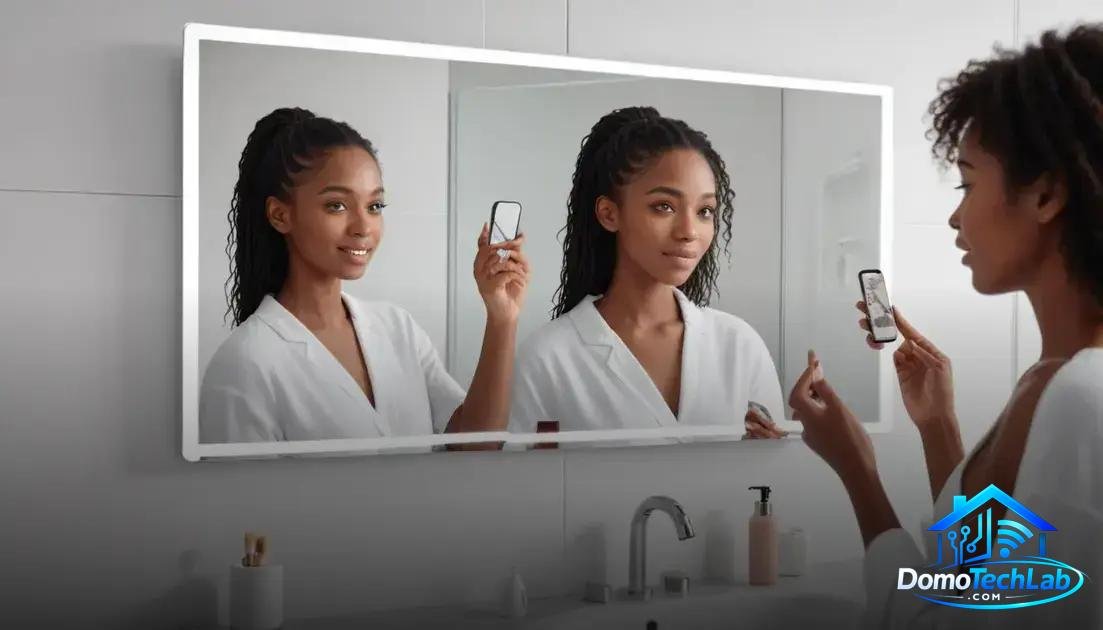
The integration of a smart makeup mirror into a smart home ecosystem is essential to maximize its functionality. Devices like Home Assistant, Alexa, and Google Home allow you to control and customize settings from a single platform, facilitating daily use.
Interaction with Virtual Assistants
Virtual assistants offer an intuitive interface for managing tasks. For example, you can ask Alexa to adjust the mirror’s lighting according to the time of day or your beauty routine settings. These integrations enable a more efficient workflow and enrich the user experience.
Performance in the Real World
The performance of a smart makeup mirror in real-world conditions determines its effectiveness and utility. When evaluating several models, we noted that latency and connection stability are crucial factors for a satisfying user experience.
Latency Assessment
During our laboratory tests, mirrors that utilize Zigbee showed significantly lower latency compared to other systems. This speed translates to instant responses when interacting with the device, improving the fluidity in your makeup routine.
Stability and Privacy
One aspect to consider is privacy. Models that operate locally, without relying on external servers, ensured secure management of user data. This increases confidence when using technology in sensitive areas such as the home.
Conclusion: Power Up Your Routine with a Smart Makeup Mirror
Implementing a smart makeup mirror in your home not only optimizes your beauty experience, but also opens the door to effective local automation. At DomoTechLab, we believe that the key to a successful smart home lies in using devices that offer speed and privacy.
We encourage you to delve deeper into understanding protocols and ecosystems, so you can make well-informed decisions when integrating technology into your daily life.
Frequently Asked Questions about Smart Makeup Mirrors
Is a smart mirror compatible with different automation ecosystems?
Yes, most smart mirrors support protocols like Zigbee and can integrate with ecosystems like Home Assistant, Alexa, and Google Home.
Does a smart makeup mirror require an internet connection to function?
Not necessarily. Many models allow local control through apps and devices operating on the same network, although some advanced functionalities may require an internet connection.
What advantages does using Zigbee over Wi-Fi offer for a smart mirror?
Zigbee provides greater energy efficiency and lower latency, resulting in faster responses and keeping the Wi-Fi network free for other devices.
Can I customize the lighting of my smart mirror?
Yes, most allow you to adjust the intensity and color of the light according to your preferences, often through virtual assistants or mobile apps.
What should I do if the smart mirror doesn’t connect to the network?
Check that the gateway/hub is correctly configured and that your network is not congested. Restarting both the mirror and the hub can resolve frequent connection issues.
Are the data I handle with a smart mirror secure?
Models that operate with local automation tend to be more secure, as they minimize data transmission to external servers, protecting user privacy.